
“I jumped at the opportunity!”
Educating clients was one of my favourite parts of being a practising vet, as it not only benefitted the client and their horse directly, but other clients and their horses indirectly through shared knowledge and an improvement in management standards. As Nelson Mandela once said ‘education is the most powerful weapon which you can use to change the world’. I also loved being on the cutting edge of veterinary medicine; take for example the use of mesenchymal stem cells used intrarticularly for the management of osteoarthritis.
As a general practise vet, it is difficult to be involved in the design and innovation side of veterinary medicine, unless you take up a job with big Pharma, so I jumped at the opportunity to work with MED Equus.
My first month was a real baptism of fire with my first conference falling at the end of my first week. The ECVS annual scientific meeting was held in the beautiful Flanders Meeting and Convention centre in Antwerp, Belgium.
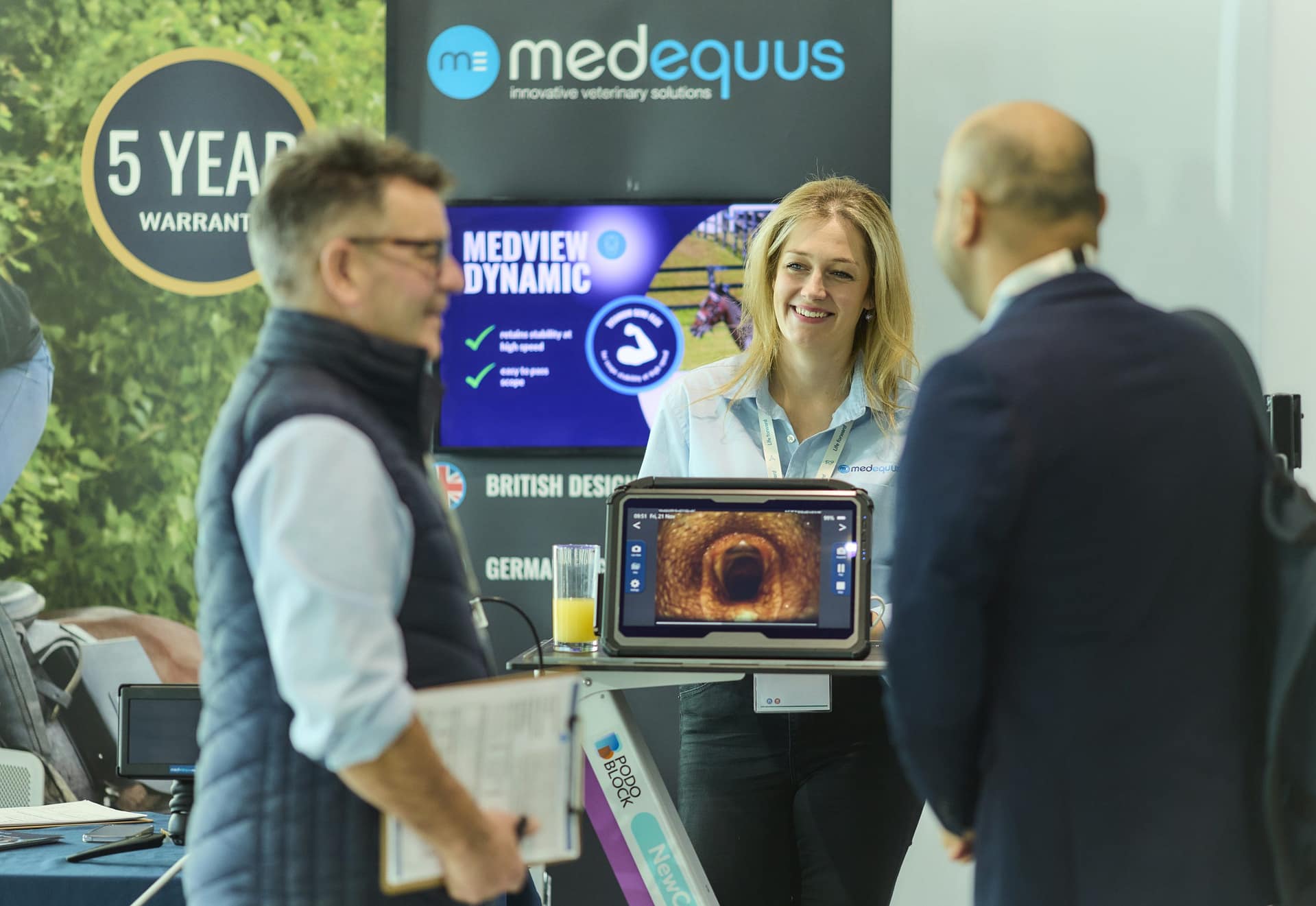
This was the first year that MED Equus had exhibited at the ECVS annual meeting, and it was great to see a few familiar faces from my time in clinical practice as well as make new contacts moving forward. It is a definitely a meeting that we will be attending annually moving forward, with the next meeting due to take place in July 2026 in Liverpool, UK.
“Watch this space!”
The ECVS meeting is one of the only conferences we attend that isn’t 100% equine vet based, and it was interesting for both Martin and I to see the sizeable difference in numbers of equine vs small animal veterinary surgeon attendees. Given that 58% of respondents to an RCVS survey in 2024 were solely working in small animal practice, with an additional 10% in mixed practice1, it is unsurprising that the majority of attendees at the ECVS meeting were small animal surgeons. As we continue evolving as a business, the possibility of venturing into small animal endoscopes is an interesting one- all I can say at this point is watch this space!
July was a laser-centred month for MED Equus, kicking off firstly with an install of a new Leonardo dual wavelength surgical diode laser system for an independent practice in Cheshire, primarily for the management of cutaneous tumours. All MED Equus equipment comes not only with a 5-year warranty but with a full install, demonstration and clinical training included for no additional cost. We are invested in making sure you get the most out of your equipment not only immediately post-sale but also in the long term- we understand the fluid nature of the veterinary industry and that vets come and go, and are always happy to provide training to new vets or refresher training to those that may need some helpful tips and tricks going forward.

“We pride ourselves on innovation and adaptability!“
Traditionally, the Leonardo laser system has always been supplied with a 10-hour laser fibre, which was designed for ensuring optimal cutting efficiency, by preventing the use of the laser fibre after it has degraded by over 50%. This is of particular importance in laryngeal laser procedures where reduced cutting efficiency leads to increased risk of post-operative swelling, longer surgical times and higher risk of a poor surgical outcome. However, for users of the system primarily treating skin tumours, we designed a new type of fibre for 3-months of use rather than 10-hours. In these cases, cutting efficiency is still important but the risks associated with post-operative swelling are of generally less clinical importance than post laser laryngeal surgery for obvious reasons.
This has been received positively as an option and we now offer as standard both options of fibre when purchasing the laser system and when ordering new fibres.
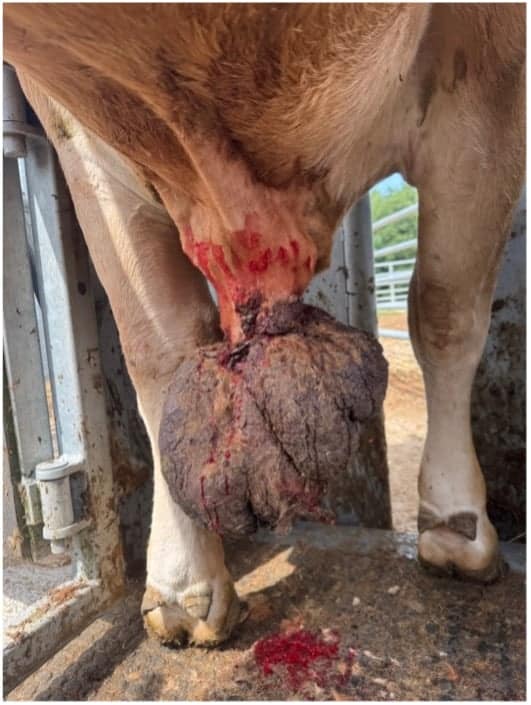
July also brought the opportunity of using the Leonardo laser system in conjunction with Nantwich Farm Vets to remove a large mass from the ventrum of a Limousine cow. MED Equus prides itself on innovation and adaptability and so we jumped at the opportunity to use the laser system in a species that, to our knowledge, it has not been used in yet.
Through vet school, you are always taught and advised to practice evidence-based medicine, and a quick PICO search revealed no published evidence of a diode laser ever having been used in a cow for mass removal. However, both CO2 and diode lasers have been used extensively in horses for cutaneous mass removal, with the first data for the use of a laser for sarcoid removal being published in the 1990s. Laser removal of sarcoids in horses has a good success rate and a low risk of recurrence. Lasers have also been increasingly used to provide haemostasis via vessel sealing intraoperatively in small animal, equine and human surgery.
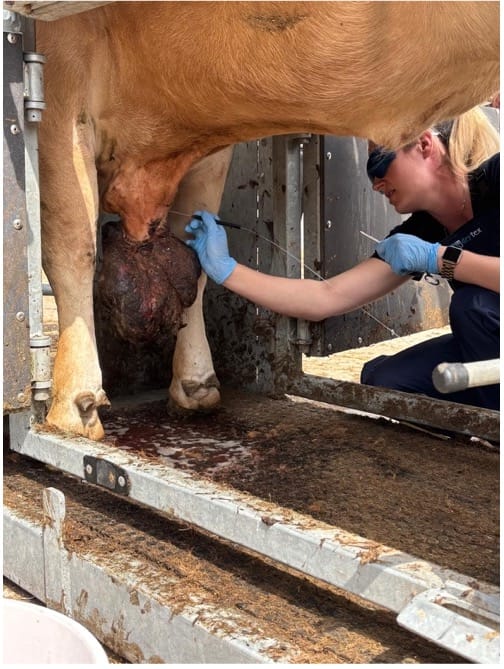
The mass had multiple small blood vessels especially within the centre of the mass’s neck which were easily sealed using the haemostasis preset on the Leonardo machine. No intraoperative tying off of vessels was required and the mass was removed in its entirety- and as you can hopefully see on the photos, it was a monster! The mass measured in at over 30cm in length, 20cm in width and approximately 8kg in weight, and on cutting open of the mass to take samples for histopathology, the tissue was white, fibrous and hard. The samples submitted to the lab revealed ulcerated and inflamed granulation tissue with no evidence of a neoplastic process, a complete surprise given the large size and rapid growth history of the mass.
The surgical site was closed with a simple interrupted suture pattern due to the large size of the site and the contaminated environment the cow lived in. Sutures were removed after 2 weeks, and there has been no recurrence of the mass over the succeeding 6 months, a true success! We hope to publish this case to highlight the adaptability of the Leonardo Dual wavelength surgical diode laser across veterinary species.
I hope you’ve enjoyed reading my first blog post – Dr. Lucy Rudd (Lead Equine Vet)